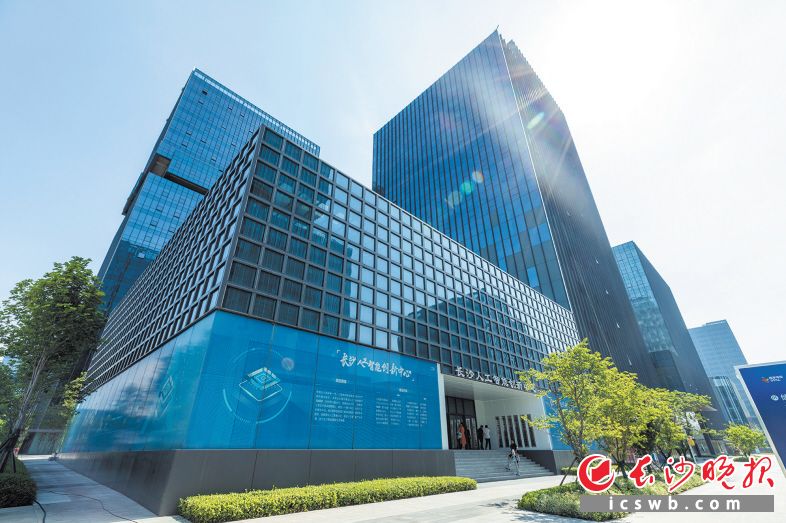
A view of the Changsha Artificial Intelligence (AI) Innovation Center.
To date, the total number of research and development institutions in Changsha has exceeded 3,800. (Photo/Dong Yang, Changsha Evening News)
In March, the Global Quantum Research and Development Center was launched in Changsha. In April, main structures of the five major buildings in the pioneering zone of Xiangjiang Science Town were capped. In May, the inauguration ceremony of Stellantis Changsha R&D Center was held. In June, high-quality projects such as the Megmeet Intelligent Manufacturing Base and Capacity Expansion R&D Center were signed to settle in Changsha. Since the beginning of this year, steadfastly pursuing its blueprint to become a "global R&D center," Changsha has accelerated its pace on the path of technological innovation, delivering impressive results. During several days of visits to research centers, laboratories, and production workshops, the reporter deeply felt that the surging momentum of technological advancement is propelling Changsha, the Star City, toward a prominent position on the global innovation map.
Creating a Premier Innovation Ecosystem to Attract Top Global Talent
In August, the passion for construction and innovation surged along both banks of the Xiangjiang River. Xiangjiang Science Town, a new town carrying Changsha's future dreams of innovation, is rising at a visible pace. The "Five Major Buildings," including the Xiangjiang Academician Port, have entered a critical phase and are expected to be operational by the end of the year, which will add 200,000 square meters of innovation space. Thirty-eight key projects including the Hunan Iron & Steel Group Technology Research Institute have a total investment of 37.3 billion CNY. Many of the projects have entered crucial stages of construction.
"One Town" leads the way, with innovation landmarks growing rapidly. The Hunan Pilot Free Trade Zone Changsha Area, as well as bases like Malanshan, Daze Lake, and Keda Jinxia, are developing at a faster pace. Projects including the Global Quantum Research and Development Center and Huawei Changsha Research Institute have successively settled. A R&D cluster map featuring "one town, one area, and three bases" is becoming increasingly clear.
If innovation is a race, top-notch R&D institutions are the core "engines." Since the beginning of this year, Changsha has made all-out efforts to "build nests to attract phoenixes," with over 60 enterprise R&D centers taking root. This list shines brightly, featuring seven projects invested by Fortune Global 500 companies, central enterprises, and state-owned enterprises, such as the Semicore ZKX Ion Implanter R&D Center; two projects invested by unicorn enterprises, including the Sugon Advanced Computing Research Institute and the Terminus Global Innovation and R&D Headquarters; and four projects invested by listed companies, such as the Hunan Megmeet Electrical Technology Co., Ltd.
To date, the "club" of enterprise R&D centers in Changsha has seen its number of members grow to 388, including 68 centers set up by central enterprises and Fortune Global 500 companies. This is not just a numerical increase, but also a reflection of Changsha's growing influence on the global innovation map.
Meanwhile, high-end platforms are accelerating to take shape. Beside the Songya Lake, the AI "Future Brain" is being nurtured, and the Aerospace Technology Research Institute stands ready to explore the vast skies. Even more notably, a "1+2" national laboratory system is moving faster to transform from a blueprint to a reality. The total number of national-level innovation platforms has reached 152, and the total number of research institutions in the city has exceeded 3,800, providing a "strong foundation" for Changsha to scale the peaks of technology.
Breakthrough Innovations from Changsha Shine on the Global Stage
The value of innovation lies in serving national strategies and driving industrial upgrades. Since the beginning of this year, Changsha's technological strength has "come to the fore," with a series of "first-ever" and "most advanced" achievements making their debut.
In March, exciting news came from the Yuelu Mountain Laboratory — the world's first prototype for nondestructive rice seed vitality detection and sorting was successfully developed! This breakthrough increases the germination rate of rice seeds to over 92%, further improving seed quality and contributing to higher crop yields on a large scale.
The Yuelu Mountain Industrial Innovation Center has rolled out and implemented 40 key common technology projects, with scientific and technological outcomes and products such as ceramic pressure sensors filling the domestic gap. Furong Laboratory has achieved two landmark research results in areas like melanoma anti-tumor immunotherapy and kidney fibrosis regulation... Achievements from the province's four major laboratories are defining numerous future possibilities.
On the industrial front, technological breakthroughs have also been frequent. Across the city, 107 key industrial technologies have been successfully tackled. Among them, the world's largest earth pressure balance (EPB) double shield hybrid tunnel boring machine, named "Qiangji," rolled off the production line in Changsha, creatively conquering challenges of tunneling in complex geological conditions.
Solid progress has been made in empowering industries with technologies. In the first half of the year, Changsha successfully secured 31 projects under the national key R&D plan. Eight of the province's top ten technology breakthrough projects are located in Changsha, including wide-temperature high-performance sodium-ion battery R&D. Their investment and R&D completion rates exceed 50%. Revised versions of the Management Measures for Changsha's Major Sci-tech Projects Undertaken Through an Open Competition Mechanism and the Management Measures for Changsha's Major Sci-tech Programs were issued. Continued efforts have been made to advance 92 municipal-level projects undertaken through an open competition mechanism and major programs. Key technological breakthroughs and the commercialization of sci-tech achievements have been further promoted. The city's sci-tech enterprise cultivation database now includes 25,000 enterprises, with the number of companies in AI and sensor industrial chains surpassing 2,500.
Recently, the Management Measures for the Filing of Sci-tech Achievements Commercialization Concept Verification Centers and Pilot-scale Testing Platforms in Changsha City were implemented, focusing on smoothing out the first and last "two kilometers" of R&D achievements commercialization. Sci-tech achievements commercialization is crucial in empowering industries with technologies. This year, Changsha has continuously promoted the reform of sci-tech systems and deepened the empowerment of job-related sci-tech achievements. A high-energy-level sci-tech innovation platform service system has been built. The first batch of 89 officials connected with 290 high-energy-level sci-tech innovation platforms, collecting 156 sci-tech achievements that can be commercialized. The "City-College (Research Institute) Innovation Development Alliance" mechanism has been deepened. The total number of municipal new-type R&D institutions has reached 16. Fifty-two sci-tech enterprises have been incubated and nurtured, including the Hunan Ntel Technology Development Co., Ltd. Even more heartwarming for enterprises is that knowledge-value-based credit loans have offered a "timely rain" of 4.3 billion CNY to 1,372 sci-tech enterprises.
Nurturing a Thriving Ecosystem Where Talent and Innovation Flourish
Innovation is, in essence, driven by talents. Changsha deeply understands the principle that "Those who attract talents will secure the future." Since the beginning of this year, the city has spared no efforts in attracting talents, nurturing talents, and fostering an ecosystem for talents, transforming this "internet-famous city" into a city where innovative talents aspire to be.
Top-tier talents are flocking to the city. The teams led by Professor Li Zexiang, Academician Liu Jingnan, Academician Peng Huisheng, and other prominent figures—whose names represent the pinnacle of their respective fields—have successively chosen to establish their projects in Changsha. Even more encouraging is the city's innovative approach to talent recruitment: the Kaiyuan International Mathematical Sciences Institute attracted one Nobel Prize laureate through a flexible recruitment arrangement.
Young talents are bursting with vitality. A talent pyramid needs both its peak and its base. Changsha has prioritized the aggregation of young innovators as a foundational and strategic pillar. The city has meticulously implemented Hunan's measures in seven aspects to support the innovation and entrepreneurship of college students and introduced a "Backpack" action plan to support young talents in starting up businesses. Four provincial-level college student entrepreneurship incubation bases were among the first to settle in Changsha, providing services and fertile ground for the innovation and entrepreneurship of young students. Additionally, 45 new "Outstanding Young Sci-tech Talents" have been recognized, bringing the total number to over 200, providing a strong core force for the future.
An innovative ecosystem "pleases the near and attracts the far." Changsha embraces the world with open arms. The city conducted 17 business matchmaking activities in the Guangdong-Hong Kong-Macao Greater Bay Area, and successfully hosted the Changsha-Hong Kong Youth Talent Exchange and Matchmaking Conference in Hong Kong, sending a clear signal to the world: it is eager to attract talents. The number of foreign experts working in Changsha has grown by 11% year-on-year, intensifying the city's international atmosphere. High-profile academic conferences such as the 2025 IEEE 8th International Electrical and Energy Conference and the 2025 Chinese Congress on Image and Graphics have put Changsha's innovative vitality into the global spotlight. The surging tides of the Xiangjiang River flow ceaselessly, day and night. During the interviews, the reporter felt that currently challenges and opportunities coexist in Changsha. With a more open mindset, pragmatic actions, and a vibrant ecosystem, Changsha is pressing ahead with unwavering resolve to become a global R&D center.